
| Fact | Traditional Marketing | Social Media Marketing |
| Best for | Broad local awareness, credibility | Targeted reach, engagement, conversions |
| Targeting | Broad, hard to segment | Highly specific audience targeting |
| Tracking results | Difficult to measure directly | Trackable in real time |
| Typical timeline | Builds awareness over time | Can show engagement quickly, sales take consistency |
| Works well for | Local services, older demographics, community trust | Product launches, e-commerce, brand engagement |
In practice, the strongest strategy is usually traditional + social, not one instead of the other. Traditional channels build awareness and trust; social media reinforces the message, drives engagement, and makes results easier to measure.
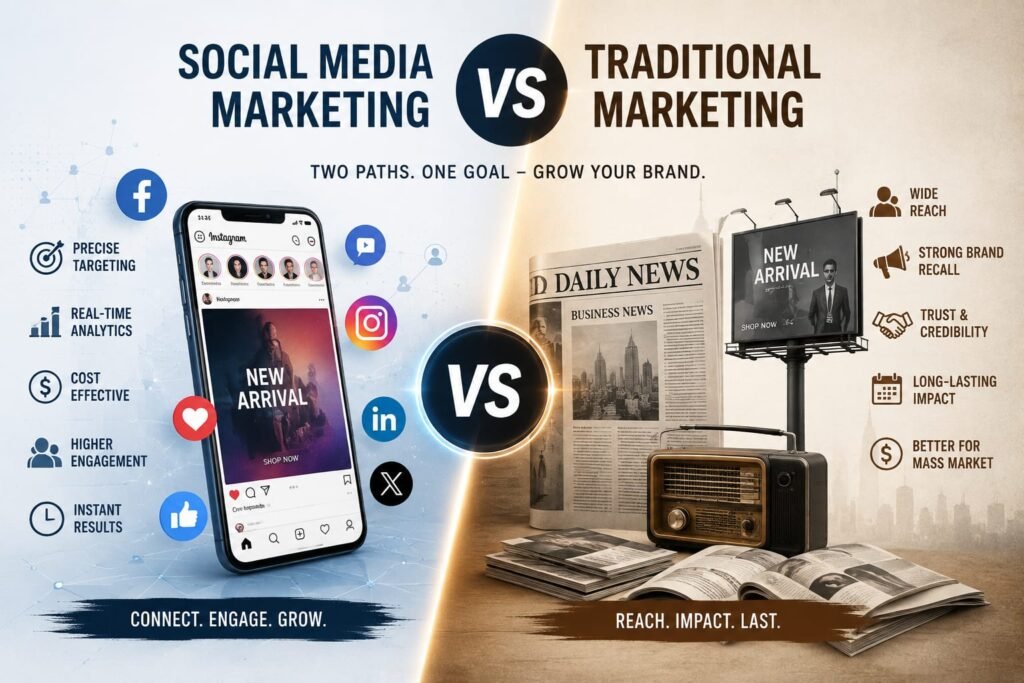
Social Media Marketing vs. Traditional Marketing: Quick Comparison
| Factor | Social Media Marketing | Traditional Marketing |
| Cost to start | Low to moderate | Often higher (print, airtime, production) |
| Speed of feedback | Immediate | Slow or unclear |
| Audience targeting | Precise | Broad |
| Best goal fit | Engagement, conversions | Awareness, credibility |
| Measurability | High | Low |
What Is Social Media Marketing, Really?
Social media marketing is the use of platforms like Instagram, TikTok, Facebook, and LinkedIn to build an audience, share content, and drive specific actions — clicks, leads, sales, sign -ups. Unlike traditional marketing, which typically pushes a message out to a broad audience, social media marketing is built around two-way interaction. Brands can target narrow audience segments, get instant feedback in the comments, and track exactly what’s working in real time.
That last part — real-time tracking — is where the real difference between social and traditional marketing shows up.
A Real Product Launch: Social Media vs. Print Advertising
The clearest example I’ve seen came from a product launch that ran two campaigns side by side.
The first was a traditional print ad placed in a local magazine. It looked polished, it reached a decent number of readers, and it built some general awareness — but that’s where it stopped. There was no reliable way to know who actually saw it, and it generated very few direct inquiries. The brand had spent money on visibility, but had almost no way to connect that spend to results.
At the same time, the brand ran a short Instagram campaign built around customer testimonials and quick product videos. The difference was immediate. Engagement climbed, website traffic increased, and — most importantly — sales followed. The campaign didn’t just create impressions; it created action.
What made the gap so obvious wasn’t just the platform. It was that social media let the brand target a specific audience, respond to comments and questions in real time, and see exactly which posts were converting. The print campaign created awareness. That awareness became quantifiable thanks to social media marketing. Social media typically excels when the objective is engagement and conversion rather than just reach.
The Most Common Error Made by Brands When Allocating Funds to Social Media
The most common error I observe is an incorrect assumption rather than a lack of effort. Brands believe that just shifting money from traditional channels to social media marketing will provide greater outcomes.
In actuality, that change frequently fails in two ways: Chasing vanity metrics. Teams focus on posting frequently or racking up likes and followers instead of creating content built for a specific platform and a specific audience.
- Expecting instant sales. Social media marketing usually requires consistent engagement and relationship-building before it converts. Treating it like a print ad — post once, expect a spike — sets the campaign up to “fail” when it’s really just early.
- Even tho it requires discipline, the solution is simple: establish clear objectives up front, experiment with a few alternative content strategies, monitor metrics that truly count (engagement, leads, conversions, not simply likes), and make adjustments based on what the data indicates rather than what feels good.
My Five-Step Social Media Campaign Planning Framework
- Goal: Clearly state the campaign’s objectives, such as raising awareness, increasing engagement, generating leads, or increasing sales.
- Audience Determine your target audience and what matters to them.
- Content Rather of using the same post everyplace, choose the appropriate format and message for each site.
- Evaluate the effectiveness of several innovative iterations, audiences, or calls to action.
- Optimize Look beyond likes to measures like clicks, conversions, and cost per result; then, allocate funds to the areas that are performing well.
- All five steps are based on the same idea: approach social media marketing as a continuous learning process rather than a one-time campaign that you start and then abandon.
When Traditional Marketing Still Wins ?

I wouldn’t call traditional marketing outdated — that’s too simple The audience and the objective determine which channel is best.
Conventional marketing typically performs better when: The target audience isn’t especially active online (think older, more local demographics
- The business needs strong local visibility — a neighborhood service business, for example
- The goal is broad awareness and credibility rather than a direct, trackable action
A local healthcare provider, a home-services company, or a community event can benefit significantly from radio, outdoor advertising, direct mail, or local print — channels that build trust in a way a scrolling feed sometimes can’t.